


-
By Pieter
-
October 9, 2026
- 0 Comment
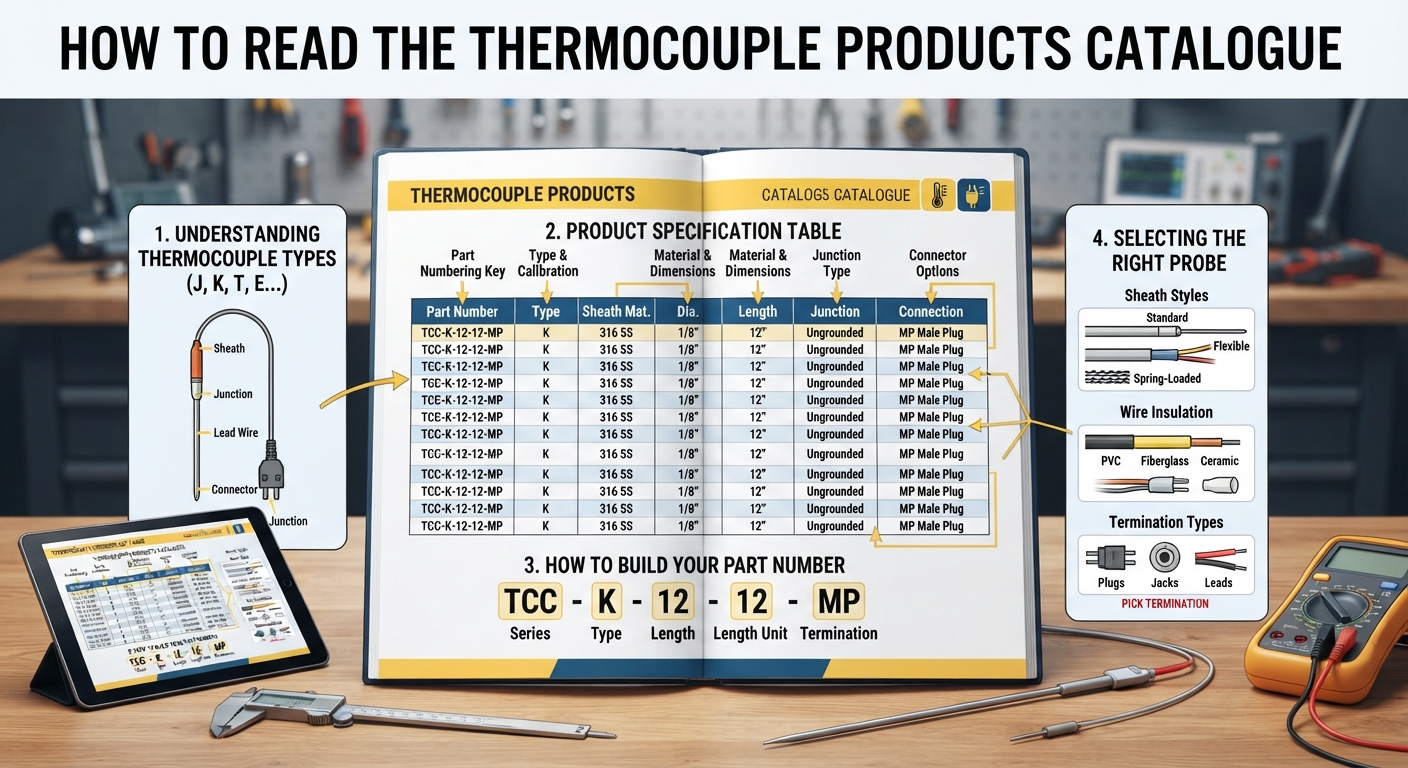
How to Read the Thermocouple Products Catalogue
The short answer: A thermocouple part number is built by choosing one option from each of seven groups — sheath diameter, element type, sheath material, junction type, immersion depth, termination and mounting. Each group has its own table of ordering codes. Join the codes with dashes and you have a complete, unambiguous specification.
The Thermocouple Products catalogue is 29 pages and contains the full ordering tables for every product manufactured in Edenvale. This guide explains how to use it — and by the end you will be able to specify a complete assembly and quote the code.
Download the catalogue: [PDF LINK]
Why ordering codes exist
A part number removes ambiguity.
“A type K thermocouple, about 150 mm, stainless, with a plug” could describe several hundred different assemblies. Sheath diameter, grade of stainless, junction type and plug style are all unspecified — and each of them changes how the sensor performs.
60 – K – 316 – U – 150 – A – FSS describes exactly one assembly. You know what you are getting, we know what to build, and if you reorder in three years you get the same thing.
The structure follows the sensor from tip to termination, which is why the codes read in the order they do.
Worked example: a mineral insulated thermocouple
Seven tables, seven decisions.
Table 1 — Sheath diameter
Code | Diameter | Conductor size | Sheath thickness | Max continuous length |
15 | 1,5 mm | 0,25 mm | 0,23 mm | 400 m |
20 | 2,0 mm | 0,33 mm | 0,28 mm | 350 m |
30 | 3,0 mm | 0,53 mm | 0,46 mm | 170 m |
45 | 4,5 mm | 0,79 mm | 0,69 mm | 70 m |
60 | 6,0 mm | 1,04 mm | 0,89 mm | 40 m |
80 | 8,0 mm | 1,31 mm | 1,12 mm | 20 m |
How to choose: thinner responds faster and fits tighter spaces; thicker lasts longer and withstands more abuse. 6,0 mm is the common general-purpose size.
What the table is really telling you: the conductor size column matters more than people realise. A 1,5 mm sheath contains 0,25 mm conductors — finer than a staple. Excellent response, but less tolerant of a harsh environment.
Table 2 — Element type
Choose the calibration: J, K, T, E, R, S or B. Doubled letters indicate duplex — KK is a duplex type K.
This table also carries the limits of error, covered further below.
Table 3 — Sheath material
Code | Material | Max temperature |
304 | 304 stainless steel | 925°C |
316 | 316 stainless steel | 925°C |
321 | 321 stainless steel | 925°C |
446 | 446 stainless steel | 1 040°C |
310 | 310 stainless steel | 1 095°C |
600 | Inconel 600 | 1 150°C |
How to choose: start with your maximum temperature, then consider the process medium. For anything corrosive, use the material selection guide at the back rather than guessing.
A point easily missed: 304, 316 and 321 all show 925°C, but they are not interchangeable. 316 resists chlorides better. 321 resists intergranular corrosion after welding. Temperature is only one axis.
Table 4 — Measuring junction
Code | Type | Characteristics |
G | Grounded to sheath | Fastest response, no electrical isolation |
U | Insulated from sheath | Slower, electrically isolated, avoids earth loops |
E | Exposed junction | Fastest of all, no protection from the process |
How to choose: use U (ungrounded) unless you specifically need speed. It avoids earth loops, which are a common cause of unstable readings. Use G where response time is critical and the process is electrically quiet. Use E only where the medium is benign and you need the fastest possible response.
Table 5 — Immersion depth
Specify in millimetres. Aim for the tip to reach the middle third of the pipe or vessel, so it sits in flowing medium rather than the boundary layer near the wall. Insufficient immersion depth is the single most common cause of inaccurate readings.
Table 6 — Termination
Thirteen options, from bare stripped conductors to connection heads:
Code | Termination |
ST | Stripped — 75 mm exposed conductors |
PS / PH | Plug — quick connect male, solid or hollow pin |
J | Jack — quick connect female |
MP / MJ | Mini plug / mini jack |
T––– | Transition with cable (specify length and PVC or Teflon) |
KH / KS | Aluminium head with screw cover, large or small |
N | Nylon head |
B | Bakelite head |
SLB | Spring loaded block |
DB | DIN block |
Table 7 — Mounting
Adjustable compression fittings (ACF) in brass or 316 stainless, from 1/8″ to 1/2″ NPT, or fixed fittings (FF) with a specified insertion length.
The result
60 – K – 316 – U – 150 – A – FSS
6,0 mm sheath · type K · 316 stainless · ungrounded junction · 150 mm immersion · plug termination · fixed stainless fitting.
Worked example: a Pt100 RTD
Shorter — five tables.
32MP – 150 – SS6 – N
- 32MP → duplex Pt 100, 3 wire, mineral insulated
- 150 → 150 mm nominal length
- SS6 → 316 stainless sheath, 6 mm outside diameter
- N → nylon connection head
For the standard (non-MI) range the codes differ slightly:
21P – 250 – 6 – KS
- 21P → single Pt 100, 2 wire
- 250 → 250 mm
- 6 → 6 mm, 316 stainless
- KS → small aluminium head
The element codes follow a logic: first digit = wire count related, second = number of elements, letter suffix = construction. 21P is 2-wire single; 32MP is 3-wire duplex mineral insulated; 23P is triplex.
Other product codes at a glance
Product | Example code | Meaning |
Standard thermocouple | K – 500 – 316-2 – KH – AFL – 22 | Type K, 500 mm, 316 S/S 21,3 mm O.D., KH head, adjustable flange |
Angled thermocouple | X – K – 600 – 446 – 400 – P21 – KH | Type K, 600 mm hot leg in 446, 400 mm cold leg, KH head |
Thermocouple insert | K – 500 – 3 | Type K element, 500 mm, 3 mm conductors |
Protection sheath | 446 – 500 mm | 446 stainless sheath, 500 mm long |
Note the angled thermocouple begins with X — the prefix denoting an angled assembly, with hot leg and cold leg specified separately.
Reading the limits of error tables
Table 2 carries the accuracy specification, and it is expressed two ways.
At lower temperatures, a fixed value. Type K to standard limits is ±2°C from 0°C to 280°C.
At higher temperatures, a percentage of reading. Above 280°C, ±3/4%.
The percentage trap
Reading | ±3/4% equals |
400°C | ±3,0°C |
600°C | ±4,5°C |
900°C | ±6,75°C |
1 200°C | ±9,0°C |
The error grows with temperature. At 1 200°C a type K may be nine degrees out and remain within specification.
Special limits of error
The catalogue lists both standard and special limits. Special limits roughly halve the permissible error — ±1°C and ±3/8% for type K.
This is available on request and is simply specified at the point of order. If two degrees changes your outcome, ask for it.
Using the material selection guide
At the back of the catalogue is a table covering 155 chemicals, each with an operating temperature, a concentration and a recommended material.
How to use it properly:
- Find your chemical — the list is alphabetical
- Check the temperature column — it is specific, not general
- Check the concentration — “ALL” means any, otherwise a figure is given
- Read the recommended material
Two traps the table exposes
Temperature changes the answer.
Chemical | Temperature | Material |
Nitric acid | 25°C | 304 stainless |
Nitric acid | 150°C | 316 stainless, tantalum |
Wet or dry changes everything.
Chemical | Condition | Material |
Chlorine | Dry, 150°C | Monel |
Chlorine | Moist, 150°C | Hastelloy C |
Specifying from the chemical name alone will eventually produce a failure.
Celsius columns
The original guide was published in Fahrenheit only. The rebuilt catalogue includes both °F and °C, with Celsius rounded to the nearest 5° since the Fahrenheit figures were themselves nominal.
If your chemical is not listed
Phone us. 155 chemicals covers a great deal, but not everything — and process mixtures frequently behave differently to any single constituent. Describe the medium, the concentration, the temperature and whether it is wet or dry.
The reference data at the back
Two further items worth knowing about:
Temperature conversion — the formulas, plus a chart of melting points for commonly used elements and alloys from tin at 232°C to tungsten at 3 410°C. Useful for sanity-checking whether a material can survive an application at all.
Time constants — relative response characteristics, expressed as the time for a thermocouple to reach 63,2% of a step change. Codes A, B and C correspond to 0,110–0,8 seconds, 0,8–1,0 seconds and 1,1–2,3 seconds respectively.
When your requirement is not in the catalogue
A catalogue is a list of what has been needed often enough to standardise. It is not a limit.
Routinely manufactured but not listed:
- Insertion lengths beyond the standard range
- Non-standard sheath diameters
- Combinations of options not shown together
- Process connections to a customer’s drawing
- Elements matched to an obsolete original
- Materials outside the standard range, on request
If you cannot build the part number you need from the tables, that does not mean we cannot make it. It means the configuration is unusual enough that we should talk about it.
Describe the application — what you are measuring, the temperature, the medium, the insertion depth and how it mounts — and we will specify it. Or send the old part and we will match it.
A practical workflow
If you know what you want: build the code from the tables, send it through, and we will quote against it.
If you know the application but not the specification: tell us the temperature, the medium, the insertion depth, the mounting and the termination. We will build the code and send it back for approval.
If you are replacing something: send the old part, a photograph with a tape measure, or the previous part number. That is the fastest route of all.
All three are normal. The catalogue exists to make the first one possible, not to make the other two unwelcome.
Download the catalogue
29 pages, fully searchable, free.
[DOWNLOAD THE CATALOGUE — PDF]
Print a copy for the workshop and keep one on the server. If you cannot find what you need in it, phone us — a significant share of what Thermocouple Products builds has never appeared in any catalogue.
CTA: Request a Quote → /contact · Call (011) 452-6617 · Email tcprod@mweb.co.za
Related reading:
- Temperature Sensor Accuracy: Drift, Calibration and Knowing When to Replace
- How to Choose a Thermocouple Sheath Material for Corrosive Service
- How to Order a Custom Heating Element or Temperature Sensor
Related products: Mineral Insulated Thermocouples · Standard Thermocouples · Pt100 RTDs · Protection Sheaths · Thermowells
FAQ schema for this page
How do I read a thermocouple part number? A thermocouple part number is built from one code per specification group, joined by dashes, following the sensor from tip to termination. In the code 60–K–316–U–150–A–FSS, 60 is a 6,0 mm sheath diameter, K is the element type, 316 is the sheath material, U is an ungrounded junction, 150 is the immersion depth in millimetres, A is the termination and FSS is a fixed stainless steel fitting.
What is the difference between a grounded and ungrounded thermocouple junction? In a grounded junction the measuring junction is welded to the sheath tip, giving the fastest response but no electrical isolation. In an ungrounded or insulated junction the measurement is electrically isolated from the sheath, which responds more slowly but avoids earth loops. Ungrounded is the safer default unless response speed is critical.
What does ±3/4% accuracy mean on a thermocouple? It means the permissible error is three quarters of one percent of the reading, so the error grows with temperature. At 400°C that is ±3,0°C, at 900°C it is ±6,75°C and at 1 200°C it is ±9,0°C. Special limits of error, available on request, roughly halve these figures.
How do I choose a sheath material for a corrosive process? Use the material selection guide in the Thermocouple Products catalogue, which lists 155 chemicals with the operating temperature, concentration and recommended material. Check the temperature and concentration columns rather than the chemical name alone, as both change the recommendation — nitric acid requires 304 stainless at 25°C but 316 or tantalum at 150°C, and chlorine requires Monel when dry but Hastelloy C when moist.
What if the configuration I need is not in the catalogue? The catalogue lists standard configurations, not the limit of what can be manufactured. Non-standard lengths, diameters, option combinations and customer-drawing process connections are made to order. Describe the application or send the original part, and Thermocouple Products will specify and manufacture a replacement.