


-
By Pieter
-
October 30, 2026
- 0 Comment
Thermowells Explained: Measuring Temperature in Pressurised Pipework Without Shutting Down
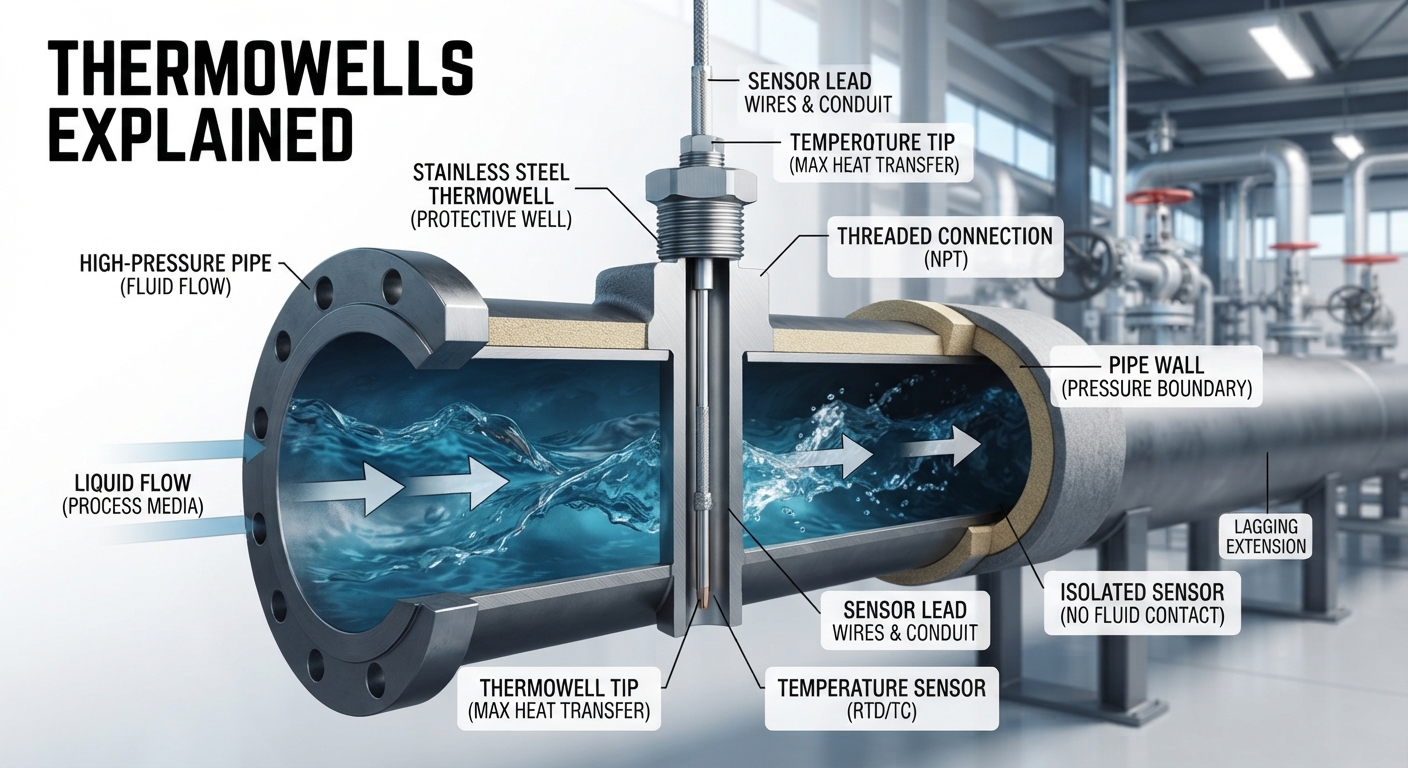
The short answer: A thermowell is a pressure-retaining fitting installed permanently in a pipe or vessel, into which a temperature sensor slides. The well holds the pressure, resists the process and takes the mechanical abuse, while the sensor inside it can be withdrawn and replaced while the plant keeps running. It is the difference between a sensor being a ten-minute maintenance item and being a shutdown event.
In most of industry, a temperature sensor is inserted directly into the process and nobody thinks twice about it. It works, and when it eventually fails, someone changes it.
Continuous process plant is different. In a power station, a refinery, a chemical plant or any process that runs around the clock, a sensor screwed directly into a pressurised, hot or hazardous line cannot simply be removed on an ordinary working day. The line must be isolated, drained, cooled and permitted before the process is opened — and then refilled and brought back on line afterwards. The sensor itself takes minutes to change. Everything around the change takes the shift, and sometimes the production plan, with it.
The predictable result is that the sensor does not get changed. It gets lived with: drifting slowly, suspected privately, and believed officially, because the alternative is a shutdown nobody will authorise for a thermometer.
A thermowell exists to break that logic.
What a thermowell actually does
A thermowell does four jobs. Specification conversations usually cover the first and stop, which is why thermowells are so often under-specified.
- It holds the pressure. The well is part of the pressure boundary of the pipe or vessel. It is installed once — by thread, flange or weld, according to the plant’s standard — and it remains there permanently, sealing the process inside.
- It takes the punishment. Pressure, corrosion, erosion from flowing media, vibration and mechanical abuse all land on the well rather than on the sensor. This distinction matters more than it is usually given credit for: a sensor sheath is built to protect a measuring junction, not to serve as a pressure vessel, and the two should never be asked to swap jobs.
- It lets the sensor be changed. The sensor — usually supplied as an insert — slides into the well’s bore and is withdrawn the same way. No isolation, no draining, no cooling, no permit to open the process. The plant runs; the sensor is changed; the well never moves.
- It makes the sensor a standard part. Because the well defines the process connection and the immersion depth, the insert inside it becomes a fixed, repeatable specification. It can be ordered by code, held as a shelf spare, and replaced in minutes — which converts the most disruptive sensor on the plant into the easiest one.
Thermowell or protection sheath?
The two are confused constantly, and ordering one where the other belongs is an expensive category error.
| Thermowell | Protection sheath |
Primary job | Retain pressure while allowing sensor removal | Protect the sensor from the process environment |
Stays in the process | Yes — permanently installed | Usually fitted with the assembly |
Sensor removable with plant running | Yes | Generally no |
Typical territory | Pressurised pipework and vessels, power, petrochemical, chemical | Furnaces, tanks and low-pressure processes |
The failure it prevents | The shutdown-to-change-a-sensor | Sensor destruction by heat, corrosion or abrasion |
In simplified terms: if opening the process is the problem, the answer is a thermowell. If the process destroying the sensor is the problem, the answer is a protection sheath. Some heavy applications need the well or sheath specified with elements of both in mind — which is why “a metal tube with a sensor in it” is not a specification.
The honest trade-off: response time
Measuring through a thermowell wall is slower than measuring with a sensor immersed directly in the process. Heat must travel through the well, across whatever gap exists between well and sensor, and into the junction. In a fast control loop, that lag is real and should be admitted rather than disguised.
Three things decide how much lag there is:
- A sensor that rattles loosely in an oversized bore is surrounded by a layer of still gas, and still gas is an insulator. The bore and the sensor diameter belong to each other; specifying one without the other is how a brand-new sensor earns a reputation for being slow.
- Tip contact. The measuring tip must reach the bottom of the well. Spring-loaded assemblies exist for precisely this purpose — holding the tip in contact with the well’s base against vibration and thermal movement, rather than wherever gravity and a stiff cable happen to leave it.
- The well must place the tip in the representative part of the flow — towards the middle third of the pipe — not in the slow boundary layer along the wall. A perfectly fitted sensor measuring the wrong layer of the process is accurately wrong.
Done properly, the arrangement gives up a little speed and buys pressure integrity, mechanical survival and a sensor that can be changed on a running plant. On the overwhelming majority of continuous process measurements, that is the correct trade — provided the three points above are actually specified rather than assumed.
The four enemies of a thermowell
Pressure is the enemy everyone specifies for. Temperature gets specified too, and the catalogue’s metal limits apply to wells exactly as they apply to sheaths: 304, 316 and 321 stainless steels to 925°C, 446 stainless to 1 040°C, 310 stainless to 1 095°C and Inconel 600 to 1 150°C. Beyond those figures, a different construction is required.
Corrosion is the enemy that works quietly for years. The Thermocouple Products catalogue includes a material selection guide covering 155 chemicals, each with a recommended material at a stated temperature and concentration — and its two standing lessons apply directly to well selection. Temperature changes the answer: nitric acid calls for 304 stainless at 25°C but 316 stainless or tantalum at 150°C. And wet or dry changes everything: chlorine dry at 150°C points to Monel, chlorine moist at 150°C to Hastelloy C. A well specified from the chemical name alone is a slow-motion leak carrying a temperature sensor.
Flow is the mechanical enemy. A well projecting into a moving stream is loaded by the flow and excited by the vortices it sheds. Long, slender wells in fast-moving media can vibrate to fatigue failure — a failure of the pressure boundary caused by geometry, not by material quality. Immersion length and well diameter are therefore a balance between reaching the process and surviving it, and where velocity is high and immersion is long, that balance should be checked by engineering rather than settled by habit.
The air gap is the enemy inside the assembly, dealt with above: the wrong insert length, a loose bore fit or a tip not held at the bottom of the well. It causes no leaks and breaks nothing, which is why it is so rarely found. It simply makes a good sensor read slowly and slightly wrong, indefinitely.
Duplex sensors: a measurement that audits itself
Duplex assemblies carry two independent elements in one sensor — a duplex type K is ordered as KK, and the same doubling applies across the range, including the noble metal types RR, SS and BB.
In continuous plant, duplex is usually justified as redundancy: one element for control, one for recording or alarm. That is reason enough. But a duplex sensor in a thermowell offers something more valuable than a spare.
Two elements measuring the same process should agree. When they begin to disagree, one of them is announcing that it is drifting — not after the batch, not at the next shutdown, but now, while the plant is still controlled by the healthy element and while the replacement can be planned, spared and fitted through the well in minutes.
Set against Week 8’s subject — the sensor that looked perfectly healthy while reading incorrectly — a duplex element pair is the closest thing temperature measurement has to a self-checking instrument. In a plant where a wrong temperature can cost a turbine, a reactor run or a product campaign, that property alone can justify the second element.
Long insertion lengths
Large pipes, ducts, vessels and flues ask a different question: not how the sensor survives the process, but whether it reaches the process at all.
Standard assemblies in the Thermocouple Products range are manufactured in nominal lengths from 100 mm to 2 000 mm, with longer lengths made on request. Length should be specified backwards from the measurement, not forwards from the flange: the tip belongs in the representative part of the process — the middle third of the flow — with the connection head outside the lagging and somewhere a person can genuinely reach it, and the insert withdrawable without heroics.
Length also interacts with the flow problem. Immersion that is correct for measurement may be severe for vibration, particularly in gas ducts and steam lines. This is one of the points where a conversation at specification stage costs almost nothing: medium, velocity, immersion and diameter considered together produce a well that is both accurate and still there next year.
Specifying the assembly: seven questions
A thermowell assembly — well, insert, element and connection — is specified completely by seven answers:
- The medium. What is in the pipe or vessel, including anything corrosive, erosive or intermittent.
- The temperature. Normal operating and the maximum the assembly will ever see, including excursions.
- The pressure. At operating conditions, since pressure and temperature together define the duty the well must hold.
- The pipe or vessel. Its size, and the flow velocity if it is known — the inputs that drive immersion length and the flow check.
- The connection. The plant’s existing standard, thread or flange — or a drawing of the point the well must fit. Matching the plant standard at order stage is free; discovering a mismatch at installation is not.
- The immersion depth. Far enough to reach the representative process, set out in millimetres, with the head clear of lagging.
- The instrument. Thermocouple type J, K, T, E, R, S or B, or a Pt100 RTD; single or duplex; and how the head or termination must suit the existing wiring.
Send those answers — or as many as you have, with a photograph or the existing assembly — and the specification can be completed from there, with the insert coded for reordering and sparing.
When a thermowell is not the answer
This guide would not be honest if it specified a well at every point. Where the process is at low pressure, easily isolated or routinely drained — a tank emptied between batches, an oven, a machine barrel — direct insertion is simpler, cheaper and faster to respond, and a thermowell adds cost and lag while buying nothing.
Thermowells earn their cost under a specific condition: where opening the process is expensive, disruptive, hazardous or impossible during operation. In those places, they do not merely earn it once. They earn it at every sensor change for the life of the plant.
The discipline, as always in temperature measurement, is to specify for the duty that actually exists — and to keep some thought for the person who will have to change the sensor in five years’ time. On a continuous plant, that person has no shutdown to hide in. Give them a well.
CTA: Request a Quote → /contact · Call (011) 452-6617 · Email tcprod@mweb.co.za
Related reading:
- Noble Metal Thermocouples: Measuring Temperature Above 1 100°C
- What a Failed Heater or Sensor Is Trying to Tell You
- Temperature Sensor Accuracy: Drift, Calibration and Knowing When to Replace
Related products: Thermowells · Thermocouple Inserts · Standard Thermocouples · Mineral Insulated Thermocouples · Pt100 RTDs · Protection Sheaths
FAQ schema for this page
What is a thermowell and what does it do? A thermowell is a pressure-retaining fitting installed permanently in a pipe or vessel, into which a temperature sensor slides. It holds the process pressure, protects the sensor from corrosion, erosion and mechanical abuse, and allows the sensor to be withdrawn and replaced while the plant continues running. It also standardises the connection and immersion depth, so the insert inside it becomes a repeatable, reorderable spare part.
What is the difference between a thermowell and a protection sheath? A thermowell’s primary job is to retain pressure while allowing the sensor to be removed without opening the process, so it is used in pressurised pipework and vessels in power, petrochemical and chemical plant. A protection sheath’s primary job is to protect the sensor from a destructive environment — heat, corrosion or abrasion — in furnaces, tanks and low-pressure processes, and the sensor is generally not removable with the plant in operation.
Can a thermocouple be replaced without shutting down the process? Yes, if it is installed as an insert in a thermowell. The thermowell forms part of the pressure boundary and remains in place; the insert is withdrawn and a replacement fitted without isolating, draining or cooling the line. Without a thermowell, a sensor fitted directly into a pressurised line normally requires a shutdown to replace.
Does a thermowell slow down temperature measurement? Yes, to a degree, because heat must pass through the well wall to reach the sensor. The effect is minimised by a close fit between the sensor and the well bore, by ensuring the measuring tip reaches and is held at the bottom of the well — spring-loaded assemblies exist for this purpose — and by immersing the tip in the representative part of the flow, towards the middle third of the pipe. Correctly specified, the small loss of speed buys pressure integrity and sensor changes without a shutdown.
Why use a duplex thermocouple in a continuous process plant? A duplex thermocouple, such as KK, carries two independent elements in one assembly. One can serve the control loop while the other serves recording, alarming or over-temperature protection. Because two elements in the same process should agree, a growing difference between them also reveals that one element is drifting — while the plant is still controlled by the other and the replacement can be planned and fitted through the thermowell in minutes.