


-
By Pieter
-
September 13, 2026
- 0 Comment
The Complete Guide to Heating and Measuring an Injection Moulding Machine
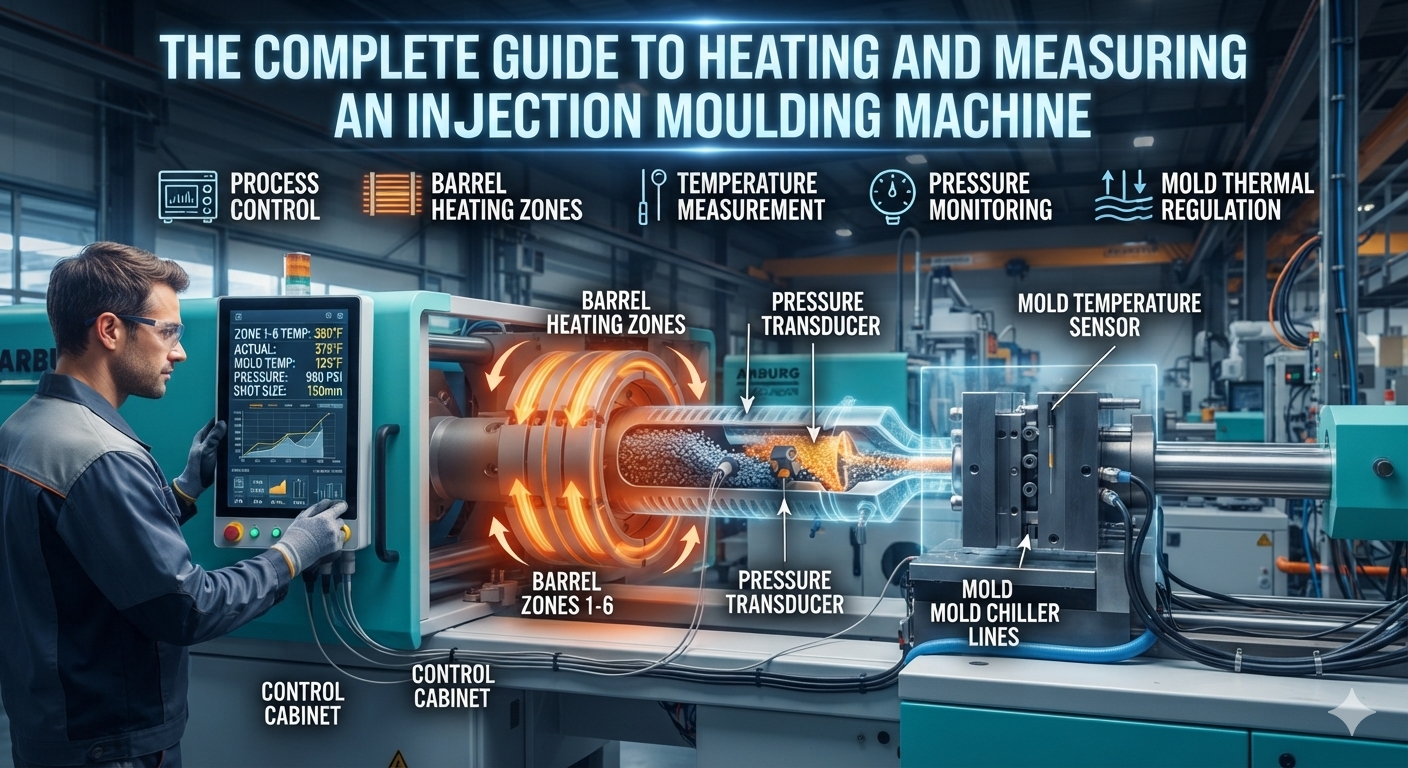
The short answer: An injection moulding machine has six or more independently heated zones — barrel, nozzle, hot runner manifold, hot runner nozzles, sprue bush and mould plates. Each needs a different heater type and its own temperature sensor. Most premature element failures are caused not by the heater itself, but by poor surface contact or by a thermocouple in the wrong position.
Thermocouple Products manufactures both the heating elements and the temperature sensors for every one of these zones, in Edenvale, Gauteng. This guide sets out what belongs where — and what goes wrong.
Why copper wire does not work
The thermal map: every heated zone
Zone | Heater type | Typical sensor |
Barrel zones | Mica or ceramic band heaters | Type J or K thermocouple |
Nozzle | Band heater or supercoil | Type J or K, often integral |
Hot runner manifold | Cartridge heaters | Type J or K thermocouple |
Hot runner nozzles | Supercoil heaters | Integral Type J or K |
Sprue bush | Supercoil or small band | Type J or K |
Mould plates | Cartridge heaters | Type J or K |
Dryer / hopper | Tubular or Incoloy elements | Type J or K |
Most plants buy these from three or four different suppliers. They can all come from one.
Barrel zones: mica or ceramic?
The barrel is usually divided into three to five independently controlled zones, from feed through to the nozzle end. Band heaters clamp around each zone and deliver heat by conduction.
Mica band heaters
- Maximum temperature: 480°C
- Watt density: 20–45 W/in²
- Strengths: fast heat-up, quick thermal response, lower cost
- Best for: standard thermoplastics on barrels in good condition
Ceramic band heaters
- Maximum temperature: 760°C
- Energy saving: insulation blanket cuts heat loss by 25–30%
- Strengths: higher temperature, lower running cost, longer life
- Best for: engineering polymers, worn barrels, energy-conscious operations
When to switch from mica to ceramic
Switch if any of these apply:
- You process above 480°C — mica is simply out of range
- The barrel is worn, pitted or slightly out of round — ceramic radiates as well as conducts, so it is far less dependent on perfect metal-to-metal contact
- You replace heaters on the same zone more than once a year
- Your workshop is uncomfortably hot — that is your heaters warming the building instead of the barrel, and you are paying to cool it back down
The insulation blanket in a ceramic heater lowers the outer sheath temperature significantly. Less waste heat means lower power consumption and a reduced cooling load on the factory.
Why barrel heaters burn out early
If you are replacing heaters on the same zone repeatedly, the heater is rarely the root cause.
Air gaps. Air is an excellent insulator. Any gap between the element and the barrel prevents heat escaping into the metal, so it accumulates inside the heater until the element fails. Gaps come from pitting, scale, out-of-round barrels and insufficient clamping.
Loose clamping. A band heater must be re-torqued after the first heat cycle — thermal expansion loosens it. This single step is skipped constantly.
Contamination under the band. Leaked and carbonised polymer creates a hot spot directly beneath the element.
Wrong watt density. Driving a heater harder than the surface can absorb cooks it from the inside.
Thermocouple in the wrong position. Covered in detail below — and this is the one most often misdiagnosed as a heater fault.
The nozzle: the zone that fails most
The nozzle runs hotter than the barrel, is physically small, is exposed to draughts and to contact with the cold mould on every cycle, and gets drooled on. It fails more often than anything else on the machine.
Heater options:
- Small band heater — where there is room
- Supercoil — where there is not
Nozzle heaters need a fast response, because the nozzle loses heat rapidly to the mould at every shot. Tight thermal control here directly affects gate quality, stringing and short shots.
Hot runner manifolds: cartridge heaters and the bore problem
Hot runner manifolds are heated by cartridge heaters inserted into drilled holes.
Construction that matters: a nichrome coil around a ceramic core, packed in high-purity magnesium oxide, sheathed in stainless steel or Incoloy, and — the critical step — swaged during manufacture. Swaging compresses the MgO, eliminating air pockets and maximising heat transfer to the sheath.
Air pockets inside a poorly made cartridge heater create internal hot spots, and hot spots are what burn elements out.
The bore is almost always the problem
A cartridge heater depends entirely on close contact with the bore around it. If the hole is oversized, oval, scaled or scored, an air gap forms. The element cannot transfer its heat into the manifold, so the heat stays inside and it fails.
If you are fitting a third cartridge heater into the same hole, measure the bore before ordering a fourth.
Typical clearance should be tight — a few hundredths of a millimetre. Anything looser and you are buying a consumable rather than a component.
Hot runner nozzles: where supercoils win
Hot runner nozzles have almost no space, need very even heat along their length, and require tight control because the polymer sitting in them degrades if it overheats.
A supercoil is built for exactly this. A flat cross-section — typically around 4,2 mm × 2,2 mm — maximises the contact area against the nozzle compared with a round-section coil of equivalent power.
The decisive feature: supercoils are commonly manufactured with a Type J or Type K thermocouple built in.
That matters more than it sounds:
- One component instead of two
- One installation instead of two
- The sensor sits exactly where the heat is produced
That last point is the whole argument. A separate thermocouple mounted “nearby” measures a delayed, averaged version of what the heater is doing. An integral sensor measures the actual zone. The control loop responds faster and overshoots less.
Supercoils can be supplied open, cast in brass or bronze for even distribution, or in a stainless jacket, with armoured or wire-braid leads.
Thermocouple placement: the mistake that kills heaters
This is the most expensive misunderstanding in the plant.
If the thermocouple is too far from the heated zone, the controller sees the temperature rising late. It keeps calling for heat that has already been delivered. The zone overshoots, then undershoots, and the heater cycles hard. Every cycle is thermal stress, and the element fails early.
The heater gets blamed. A new one is fitted. It fails too.
Placement principles:
- Close to the heat source, but measuring the process, not the element
- Consistent between zones — so the controller behaves predictably
- Properly secured — a loose sensor reads air as much as metal
- Correct immersion depth — the tip must reach the metal it is meant to measure, not sit in a partly-open hole
- Protected from mechanical damage — machine movement destroys leads
Diagnostic: if a zone consistently overshoots on start-up and then hunts around setpoint, sensor placement or controller tuning is the cause — not the heater.
Which thermocouple type for plastics?
Type J (iron/constantan) is the traditional choice in plastics processing, covering −250°C to +750°C. It remains extremely common on older machines and in hot runner systems, and many controllers are configured for it by default.
Type K (chromel/alumel) covers −180°C to +1 100°C and is the general-purpose standard. It handles moist environments better than type J, whose iron leg can rust.
In practice: match whatever the machine and controller were built for. Mixing types across a machine is a reliable route to confusion, and fitting a type K sensor to a controller set for type J produces a smooth, believable, entirely wrong reading.
And the cable matters as much as the sensor. Extension cable must match the thermocouple type, with correct polarity — the negative conductor is red on every type. Ordinary copper wire introduces error at every junction.
Zone control: why zone one always overshoots
The first barrel zone is usually the worst behaved, for three reasons:
- It is next to the cold feed throat, so it loses heat constantly in one direction
- Incoming material is cold and absorbs heat unevenly
- It is often physically shorter than the others but rated similarly
What helps: tune each zone independently rather than copying settings across them, and consider a lower watt density on zone one. If overshoot persists, check the sensor position before adjusting anything else.
A maintenance schedule worth following
Weekly
- Visually inspect band heaters for discolouration, bulging or cracking
- Check for polymer leaks under bands
- Confirm all zones reach and hold setpoint
Monthly
- Re-torque band heater clamps
- Check thermocouple terminations for tightness
- Inspect leads for abrasion where the machine moves
Quarterly
- Measure resistance across cartridge heaters to spot early degradation
- Compare zone readings against a reference thermometer
- Inspect barrel surfaces at the next material change
Annually
- Calibrate or replace critical thermocouples
- Measure hot runner bores where elements have been replaced
- Review failure history by zone — a pattern points to a root cause, not bad luck
One supplier for the whole machine
Thermocouple Products manufactures, in Edenvale:
Heating: mica and ceramic band heaters · cartridge heating elements · supercoil heaters with integral thermocouples · Incoloy elements · NFG high-temperature cable
Measurement: type J and K thermocouples in every configuration · Pt100 RTDs · extension cable and connectors · controllers and indicators
Everything is built to order — custom diameters, widths, cutouts, terminal types, lead lengths and thermocouple positions — with no import lead time and no minimum order quantity.
If a zone goes down on a Tuesday afternoon, a local manufacturer is a different proposition from an import order.
What to send us
For heaters:
- Dimensions — internal diameter and width for bands, diameter and length for cartridges
- Wattage and voltage
- Terminal type — leads, screw terminals, plug
- Cutouts or holes required
- The old element — if you have it, send it and we will match it
For sensors:
- Type — J or K
- Insertion length
- Termination and fitting
- Where it mounts
Not sure? Describe the machine and the zone, and we will specify it.
CTA: Request a Quote → /contact · Call (011) 452-6617 · Email tcprod@mweb.co.za
Related reading:
- Band Heaters, Cartridge Heaters and Supercoils: Which One Does Your Machine Need?
- Thermocouple Extension Cable: The Hidden Cause of Measurement Error
- Why Is My Thermocouple Reading Wrong? 8 Common Causes
Related products: Mica Band Heaters · Ceramic Band Heaters · Cartridge Heating Elements · Supercoil Heating Elements · Thermocouples
FAQ schema for this page
Why do my band heaters keep burning out? The most common causes are air gaps between the heater and the barrel, caused by a worn, pitted or out-of-round surface or insufficient clamping; polymer leaking and carbonising under the band; excessive watt density for the surface; and a thermocouple positioned too far from the zone, which makes the controller cycle the heater hard. The heater itself is rarely the root cause.
Should I use mica or ceramic band heaters on an injection moulding machine? Mica band heaters operate to 480°C and offer fast response at lower cost, suiting standard thermoplastics on barrels in good condition. Ceramic band heaters operate to 760°C, reduce heat loss by 25–30% and transfer heat by radiation as well as conduction, making them more tolerant of worn or out-of-round barrels and cheaper to run.
Why do cartridge heaters fail in hot runner manifolds? The usual cause is bore fit. A cartridge heater relies on close contact with the drilled hole to transfer heat into the manifold. If the bore is oversized, oval, scaled or scored, an air gap forms, the element cannot shed its heat and it overheats internally. If elements repeatedly fail in the same position, the bore should be measured before fitting another.
Where should the thermocouple be positioned on a heated zone? The thermocouple should sit close to the heat source but measure the process metal rather than the element itself, be securely fitted at the correct immersion depth, and be positioned consistently across zones. A sensor too far from the zone causes the controller to respond late, producing overshoot and hard cycling that shortens heater life considerably.
What is a supercoil heater and why use it on hot runner nozzles? A supercoil is a compact coil heater with a flat cross-section, typically around 4,2 mm × 2,2 mm, that wraps tightly around small cylindrical components where a band heater will not fit. Supercoils are frequently manufactured with an integral Type J or K thermocouple, combining heater and sensor in one component so that temperature is measured exactly where the heat is generated.