


-
By Pieter
-
September 27, 2026
- 0 Comment
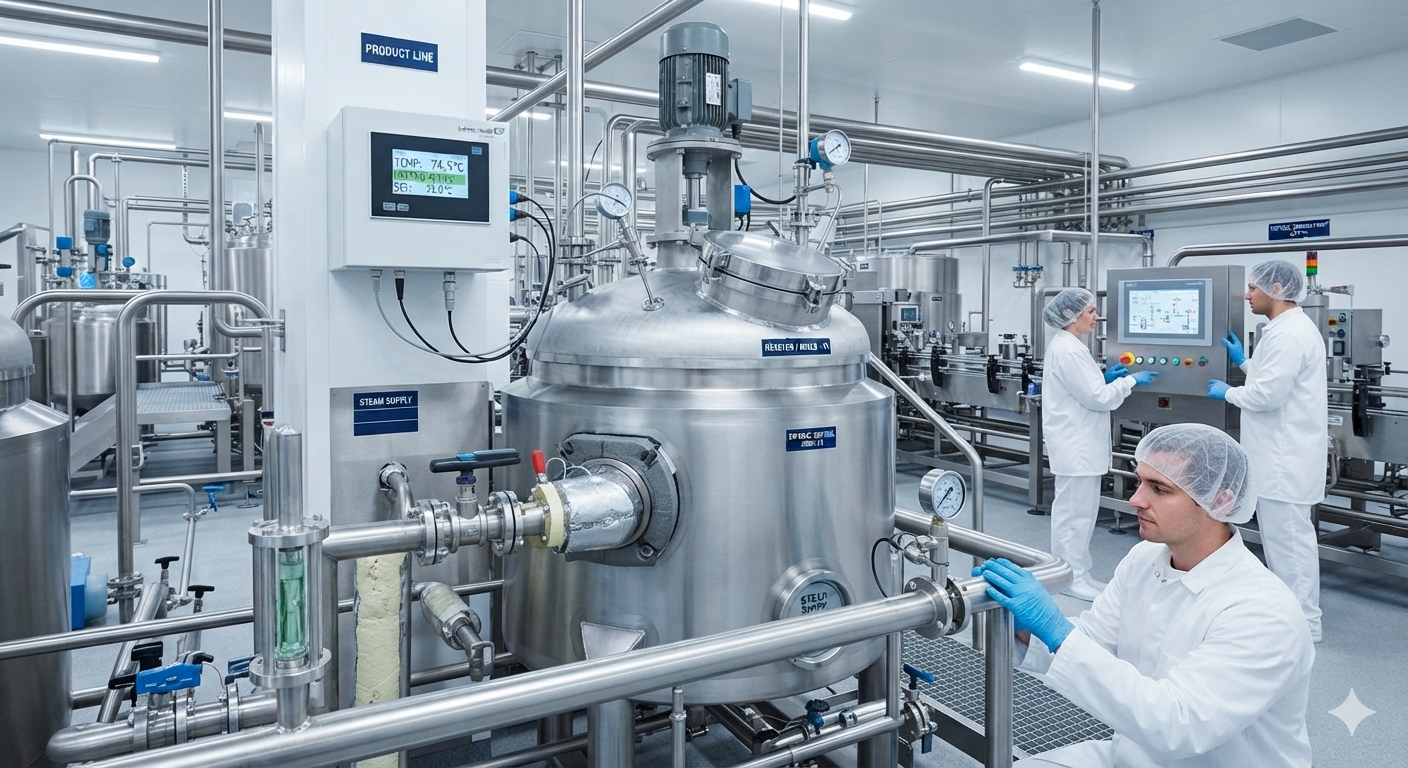
Temperature Measurement and Heating in Food, Beverage and Pharmaceutical Production
The short answer: Food, beverage and pharmaceutical production specifies Pt100 RTDs rather than thermocouples because stability matters more than temperature range — a drifting sensor produces a plausible but wrong reading, and in this sector that means a failed batch rather than scrap. Sensors should be 316 stainless minimum, crevice-free, installed at correct immersion depth, able to survive CIP and SIP cycles, and removable without opening the process.
Thermocouple Products manufactures Pt100 RTDs, hygienic sensor assemblies, thermowells and Incoloy heating elements for this sector at its facility in Edenvale, Gauteng.
Why this sector plays by different rules
In general industry, a temperature measurement controls a process. Here, the temperature measurement is the record that proves the process was safe.
A pasteuriser that ran three degrees cool did not make a poor product. It made a product that never received its validated kill step — and if the sensor was reading correctly at the time, nobody knows.
That single difference drives every decision that follows:
- Stability outranks range. Processes rarely exceed 150°C, so the enormous temperature range of a thermocouple is irrelevant. Consistency over years is not.
- The sensor is product-contact equipment. It is inspected and audited as such.
- Verification must be practical. A sensor you cannot check without shutting down will not get checked.
- Documentation matters. The measurement has to be defensible.
Pt100 versus thermocouple: why this sector chooses Pt100
Thermocouples drift. Prolonged service, thermal cycling, oxidation and contamination gradually shift their output. The failure mode is the dangerous part: a drifted thermocouple does not go open circuit or read obviously wrong. It returns a smooth, stable, entirely believable number that happens to be incorrect.
Pt100 RTDs are substantially more stable. Platinum’s resistance-to-temperature relationship barely changes over years of normal service. A Pt100 installed five years ago is far more likely to still be accurate than a thermocouple of the same age.
Since most food and pharmaceutical processes operate well below 600°C — the practical ceiling for a Pt100 in 316 stainless — there is rarely a reason to accept thermocouple drift.
| Thermocouple | Pt100 RTD |
Stability over years | Drifts | Excellent |
Accuracy | Moderate | High |
Range | −250°C to 1 700°C+ | −200°C to ~600°C |
Failure mode | Plausible wrong reading | Usually obvious |
Suits food/pharma | Limited cases | Standard choice |
Where thermocouples still make sense in this sector: oven and bakery applications above 600°C, direct-fired equipment, and fast-response measurement where a slower RTD would lag.
2-wire, 3-wire or 4-wire: the error you may be carrying
A Pt100 measures temperature as a resistance. The resistance of the connecting cable is included in that measurement unless it is compensated.
2-wire — cable resistance is added directly to the reading, producing an error that always reads high. On a long run this is not trivial. Acceptable only for very short connections or non-critical indication.
3-wire — a third conductor lets the instrument measure and cancel most of the lead resistance. This is the industrial standard and the correct default.
4-wire — eliminates lead resistance entirely by measuring voltage across the element with a separate pair. Used for reference, laboratory and calibration work.
Worth checking this week: if you have 2-wire Pt100 sensors on long cable runs in a critical application, you are carrying a permanent positive offset. It is a straightforward thing to verify and a cheap thing to correct.
Hygienic design: what actually matters
Material
316 stainless steel is the baseline. Its molybdenum content gives resistance to chlorides and pitting that 304 does not have — relevant anywhere there is brine, salt, or chlorinated CIP chemistry. Thermocouple Products supplies Pt100 sheaths in 316 stainless from 3 mm to 12 mm diameter as standard.
No crevices
Any gap, step or thread where product can lodge is both a cleaning problem and a contamination risk. Continuous welded construction and a properly matched process fitting matter more here than in general industry.
Insertion depth
The sensor tip must sit in flowing product, not against the pipe wall and not in a dead leg.
- Too shallow — you are measuring the pipe as much as the product, and the reading is pulled toward ambient
- In a dead leg — you are measuring stagnant material that may be at an entirely different temperature to the flow
As a general rule the tip should reach the middle third of the pipe.
Surviving CIP and SIP
Clean-in-place and steam-in-place cycles are frequently more aggressive than the process itself. A sensor must tolerate repeated caustic, acid and steam exposure — not just the product temperature. Specify for the cleaning cycle, not the process.
Removable without opening the line
This is where a thermowell justifies its cost. It allows the sensor to be withdrawn, verified and refitted without breaking sterility, draining the line or stopping production.
A sensor that is difficult to verify will not be verified. Designing for easy removal at installation saves years of awkward compromise.
Duplex sensors: verification without a second penetration
A duplex Pt100 contains two electrically independent elements inside one sheath.
Three practical uses:
- Control and monitor — one element drives the loop, the second feeds independent monitoring or a recorder
- Cross-check — two readings from the same point. A divergence between them is an immediate signal that one has failed or drifted
- Installed spare — if one element fails, switch to the second without stopping production or opening the process
Every one of those benefits comes through one penetration into the vessel or pipe. In hygienic design, fewer penetrations is always better.
Thermocouple Products manufactures Pt100 sensors in single, duplex and triplex configurations.
Heating: Incoloy and the limescale problem
Temperature measurement is half the picture. Where this sector heats water, product or cleaning solution, the element specification matters just as much.
Why elements fail in water
Limescale and mineral deposits build up on the element surface. Scale is an insulator. As it thickens, the element can no longer transfer heat into the water, so heat accumulates internally until the element cooks itself from the inside. Standard 304 and 316 stainless sheaths also pit and crack under repeated thermal and chemical stress.
Why Incoloy is specified
Incoloy is a nickel-iron-chromium superalloy:
- Continuous operation to 870°C without loss of mechanical strength
- Resists limescale and mineral build-up
- Highly resistant to chloride stress-corrosion cracking — relevant in chlorinated water and marine environments
- Substantially outlasts stainless in hard water
This matters in South Africa. Much of the country has hard water, and chlorinated water is standard in food production. If elements are failing more than once a year in a water application, the alloy is usually the cause rather than the element itself.
Typical applications: commercial water heaters, fryers, ovens, griddles, dishwashers, CIP solution tanks and chemical immersion.
Heating tanks you cannot drain
Two solutions, for two different situations.
Ceramic withdrawables
Resistance wire threaded through refractory ceramic bobbins, housed inside a sealed metal pocket welded into the tank. The element never contacts the contents.
The advantage is maintenance. The element can be withdrawn, inspected and replaced from outside, with the tank still full.
This is essential where the contents solidify when cold — wax, fats, chocolate, bitumen, molten materials. Draining those to change an element converts a small job into a major one.
Over-the-side immersion heaters
Installs through the open top of a tank rather than through the wall. The terminal housing sits over the rim, a cold riser runs down the inside, and the heated section sits at the bottom or along the side.
- No tank modification — no drilling, no welding, no flanges
- Portable — remove for cleaning, or move between vessels
- Sheath options — stainless steel, titanium, Incoloy or fluoropolymer (Teflon) for oils, corrosive chemicals, water and plating baths
Choosing between them: if the tank has a pocket, or one can be welded in, use a withdrawable. If the tank cannot be modified at all, or the heater must move between vessels, go over the side.
Calibration and verification
Calibration frequency depends on how critical the measurement is and how hard the sensor works. Common practice:
- Critical / regulated measurements — every 6 to 12 months
- General process control — annually
- Non-critical indication — every 2 years, or on suspicion
Check more often where the sensor sees frequent thermal cycling, aggressive CIP chemistry, mechanical vibration, or where it has been physically disturbed.
Practical verification between formal calibrations
- Ice point check — a properly made ice bath sits at 0°C and is a genuinely useful field reference
- Cross-check against a duplex element — divergence indicates a problem
- Compare against a calibrated reference probe at the same point
- Trend review — a sensor slowly departing from its historical relationship with neighbouring sensors is drifting
Ask your supplier what documentation accompanies a sensor. In audited environments, knowing the material specification, construction and any certification available can matter as much as the sensor’s performance.
What to tell us when specifying
- Process and product — what is being measured, and the medium
- Temperature range — normal operation and CIP/SIP maximum
- Accuracy required — and whether it is a critical control point
- Installation — pipe or vessel, diameter, existing fitting or thermowell
- Insertion length and process connection
- Cleaning regime — CIP chemistry, SIP temperature and frequency
- Configuration — single, duplex or triplex; 2-, 3- or 4-wire
- Any documentation requirements for your quality system
If you are replacing an existing sensor, the old unit answers most of these.
Manufactured in Edenvale
Thermocouple Products has manufactured temperature sensors in Edenvale, Gauteng since 1992, supplying food, beverage and pharmaceutical producers alongside general industry.
For measurement: Pt100 RTDs in 2-, 3- and 4-wire, single, duplex and triplex configurations, 3 mm to 12 mm in 316 stainless, 50 mm to 2 000 mm insertion lengths, with thermowells and hygienic process fittings.
For heating: Incoloy elements to 870°C, ceramic withdrawables, over-the-side immersion heaters in stainless, titanium, Incoloy or Teflon.
All built to order, with no minimum order quantity and no import lead time.
CTA: Request a Quote → /contact · Call (011) 452-6617 · Email tcprod@mweb.co.za
Related reading:
- Thermocouple vs Pt100 RTD: Which Temperature Sensor Should You Use?
- How to Choose a Thermocouple Sheath Material for Corrosive Service
- How to Order a Custom Heating Element or Temperature Sensor
Related products: Pt100 RTDs · Thermowells · Incoloy Heating Elements · Ceramic Withdrawables · Over-The-Side Immersion Heaters
FAQ schema for this page
Why does the food industry use Pt100 RTDs instead of thermocouples? Pt100 RTDs are substantially more stable over time than thermocouples. A thermocouple drifts with age and thermal cycling, and its failure mode is a smooth, believable but incorrect reading — which in food or pharmaceutical production can mean a batch that never received its validated thermal treatment. Since most processes in this sector operate below 600°C, the wider range of a thermocouple offers no advantage.
What sheath material should be used for food-grade temperature sensors? 316 stainless steel is the baseline for food and pharmaceutical applications. Its molybdenum content provides resistance to chlorides and pitting that 304 stainless lacks, which matters wherever brine, salt or chlorinated CIP chemistry is present.
Why do heating elements fail in hard water? Limescale and mineral deposits build up on the element surface and act as an insulator. The element can no longer transfer heat into the water, so heat accumulates internally until it fails. Incoloy sheathed elements resist scale build-up and chloride stress-corrosion cracking, and significantly outlast standard stainless steel in hard or chlorinated water.
How can I heat a tank without draining it to service the element? Use a ceramic withdrawable element, which sits inside a sealed pocket welded into the tank and can be removed from outside while the tank remains full. Alternatively an over-the-side immersion heater installs through the open top of the tank, requires no drilling or welding, and can be lifted out for cleaning or moved between vessels.
How often should Pt100 sensors be calibrated in food production? Critical and regulated measurements are commonly calibrated every 6 to 12 months, general process control annually, and non-critical indication every two years. Sensors exposed to frequent thermal cycling, aggressive CIP chemistry or mechanical disturbance should be checked more often. A duplex sensor allows continuous cross-checking between two independent elements at the same point.