


-
By Pieter
-
October 25, 2026
- 0 Comment
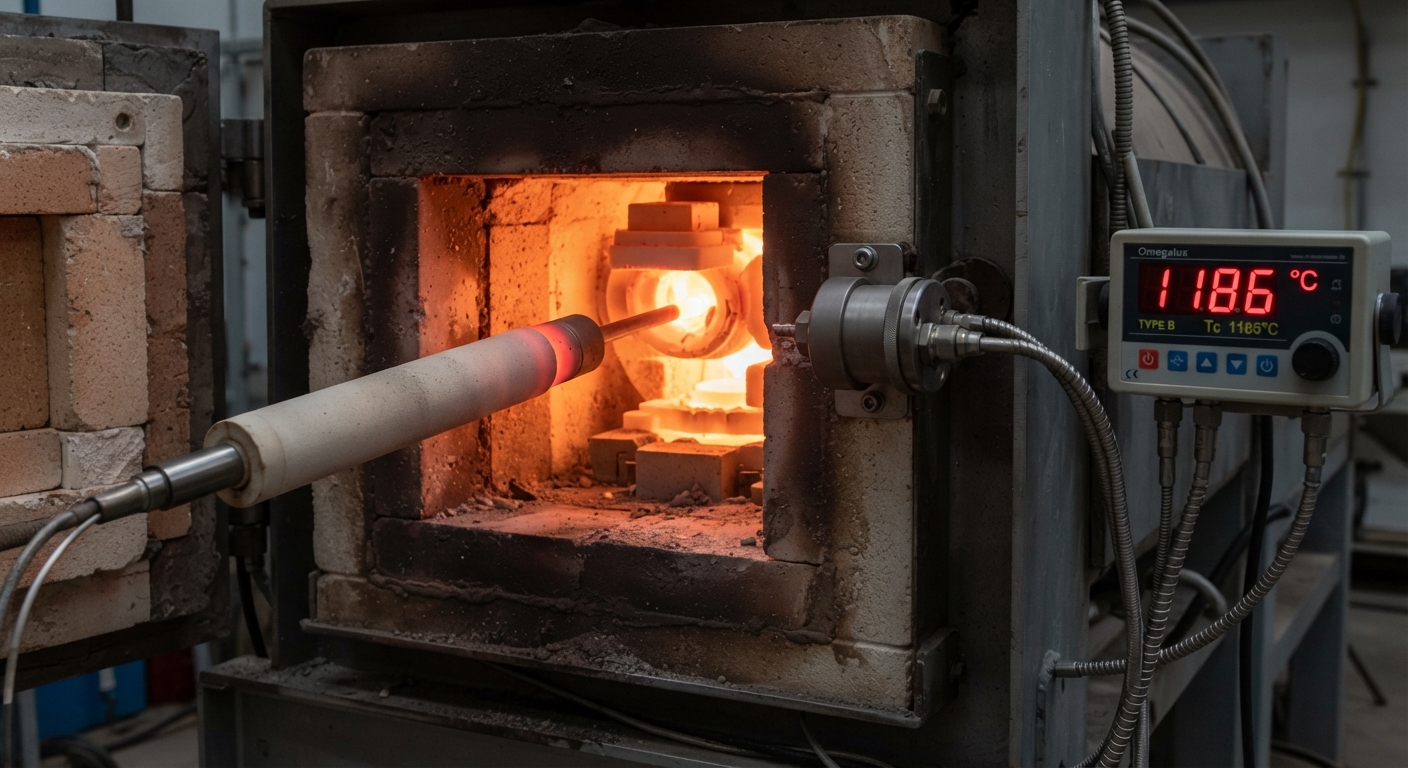
Noble Metal Thermocouples: Measuring Temperature Above 1 100°C
The short answer: Above the +1 100°C ceiling of a type K thermocouple, temperature is measured with noble metal thermocouples — types R, S and B, built from platinum and platinum-rhodium alloys and rated to 1 600°C. The element, however, is only half the specification. Metal sheaths end at 1 150°C, so the protection tube, the furnace atmosphere, immersion depth, the instrument input type and whether the insert can be replaced separately decide how long a high-temperature sensor actually survives.
Every plant that melts, fires, treats or burns at serious temperatures reaches the same point. The process needs to run hotter, or be measured more honestly — and the type K thermocouple that has served everywhere else in the factory is simply outside the range it was built for.
What follows is not an argument for buying expensive sensors. Platinum thermocouples cost more because platinum costs more, and for a large share of industrial work they are entirely unnecessary. It is a guide to the territory above 1 100°C: what the options are, why there are three of them, and the specification decisions that matter more than the choice between them.
Thermocouple Products manufactures thermocouples in types J, K, T, E, R, S and B in Edenvale, Gauteng, in single and duplex configurations. This article covers the top of that range — the end used by foundries, steel and heat treatment operations, and heavy industry generally.
Where base metal types stop
The everyday thermocouples are called base metal types: their conductors are made from common alloys, they are economical, and between them they cover most of the industrial world.
Type | Composition | Temperature range | Typical territory |
J | Iron / constantan | −250°C to +750°C | Dry, reducing or vacuum atmospheres |
K | Chromel / alumel | −180°C to +1 100°C | The general-purpose workhorse |
T | Copper / constantan | −250°C to +370°C | Low and cryogenic temperatures |
E | Chromel / constantan | 0°C to +870°C | Highest EMF output per degree |
Type K’s +1 100°C is not a suggestion or a conservative rating to be stretched for a quiet life. It is the top of the range in which the sensor is specified to work. A process running continuously at 1 200°C, 1 350°C or 1 500°C is not a type K application with a shorter replacement interval — it is a different class of measurement, and it needs a different class of sensor.
Between them, the base metal types still do the overwhelming majority of industrial temperature measurement, and nothing in this article changes that. The question is only what happens above them.
The noble metal types: R, S and B
Noble metal thermocouples use platinum and platinum-rhodium alloys for both conductors. Platinum survives temperatures that destroy base metal conductors, which is what buys the extra 500 degrees.
Type | Composition | Temperature range |
R | Platinum 13% rhodium / platinum | 0°C to 1 600°C |
S | Platinum 10% rhodium / platinum | 0°C to 1 600°C |
B | Platinum 30% rhodium / platinum 6% rhodium | Up to 1 600°C |
Why three types exist
It is the first question every buyer asks, and it has a practical rather than a theoretical answer: the three types were standardised at different times for the same territory, and entire installed bases of furnaces, controllers, transmitters and recorders were built around each one.
Type S, with 10% rhodium in the positive leg, is the long-established reference type, embedded in decades of furnace practice. Type R, at 13% rhodium, is a close relative with a slightly different composition and output, specified across a similarly large installed base. Type B puts rhodium in both legs — 30% and 6% — a construction suited to sustained work at the top of the range.
For a new installation, the choice among them is made with the instrument supplier and the duty in view. For the far more common case — replacing a sensor in an existing furnace — the choice has usually already been made for you, which leads to the point that causes the most expensive mistakes at this end of the range.
R, S and B are not interchangeable
All three types measure to 1 600°C. All three are platinum. It is tempting to treat them as near enough.
They are not. Each type produces a different voltage at the same temperature, because each pairing of alloys has its own thermoelectric behaviour. A controller, transmitter or recorder is configured for exactly one input type and converts voltage to temperature using that type’s table.
Fit a type S sensor to an instrument configured for type R, and the instrument will faithfully convert the wrong voltage with the wrong table. The display will be steady. The trend will look sensible. The furnace will be controlled to a temperature it is not at.
This is the high-temperature version of the most expensive failure in temperature measurement: not a sensor that fails, but a reading that is believed. At 1 300°C in a furnace, the cost of believing it is measured in castings, product quality or refractory life rather than in sensors.
The check costs nothing and takes a minute: confirm the instrument’s input type before ordering the sensor. It is the first question a supplier should ask you about a noble metal order, and worth noting if they do not.
Duplex: two elements, one assembly
Noble metal thermocouples are available in duplex configurations — RR, SS and BB — with two independent measuring elements in a single assembly.
In high-temperature service a second element earns its place in three ways:
- Control and recording separately: one element runs the control loop, the other feeds a recorder or data logger, without the two systems interfering
- Independent over-temperature protection: a second element driving an alarm or cut-out through a separate instrument, so a single sensor failure cannot disable both control and protection
- Continuity: where changing a sensor means cooling a furnace or interrupting a campaign, a second element provides a measurement to fall back on
At ordinary temperatures, duplex is a convenience. At 1 400°C it is frequently the cheapest insurance in the installation.
The protection problem: the element is not what dies
Here is the arithmetic that governs high-temperature sensor design:
Material | Maximum temperature |
304 / 316 / 321 stainless steel sheath | 925°C |
446 stainless steel sheath | 1 040°C |
310 stainless steel sheath | 1 095°C |
Inconel 600 sheath | 1 150°C |
Noble metal element (R, S, B) | 1 600°C |
The element out-ranges every metal sheath available to protect it by some 450 degrees. Above roughly 1 150°C, a metal sheath is no longer an option at all, and the element must be carried in a non-metallic protection tube selected for the temperature and the atmosphere of the application.
This reframes the whole specification. At ordinary temperatures the sheath is largely a mechanical decision. At foundry temperatures the protection tube is the component in direct negotiation with the process — and in service, it is usually the component that fails.
What the protection is up against
Thermal shock. A protection tube taken from ambient into a furnace, or meeting radiant heat and cold charge alternately, is stressed by every cycle. Heat after heat, the cycling accumulates. How an assembly is introduced into service and how the process cycles matter as much as the peak temperature.
Slag, splash and coating. Material from the process attacks the tube chemically, coats it — changing its thermal behaviour and therefore the reading — or erodes it mechanically.
Atmosphere. Furnace gases and metal vapours that penetrate to the element contaminate platinum, and platinum is unforgiving of contamination: the thermoelectric behaviour of the conductors changes, and the sensor drifts. Keeping the process away from the element is a protection specification, not an element specification.
Abrasion and impact. Charging, cleaning, stirring, moving product — a melt shop is mechanically violent in ways a chemical plant is not, and the assembly mounting has to survive the workplace as well as the temperature.
Specify the element for the temperature. Specify the protection for everything else. A sensor correctly specified on the first count and guessed on the second will fail early, and the failed part will be the cheap-looking one — wrapped around the expensive one it was meant to protect.
A note on limits: protection tube materials and their temperature limits are application-specific, and the correct material depends on the furnace atmosphere as well as the temperature. Confirm the material for your application when specifying — this is precisely the part of the order worth a conversation.
The replaceable insert: change the part that ages
A thermocouple insert is the measuring element assembly on its own, separate from the protection sheath or tube it works inside.
In heavy service, this separation is worth designing for. The protection sheath stays installed in the furnace — undisturbed in its mounting, its flange and its process connection. When the element reaches the end of its life, the insert is withdrawn and a new insert fitted.
The component exposed to the process and carrying the installation cost stays in place. The component that ages is the component that gets changed — without cooling more of the plant than necessary, and without breaking and remaking the installation around it.
On a small sensor this is a nicety. On a large high-temperature assembly, over several element changes, it is the difference between a maintenance task and a project.
When NOT to buy platinum
An honest guide to noble metal thermocouples should spend a paragraph talking you out of them, because the oversold sensor is the one that gives the technology a reputation for being expensive.
Stay with base metal when:
- the process maximum, including excursions, is within type K’s range — a type K in an Inconel 600 sheath at 1 050°C is a sound, economical specification
- the duty is moderate and replacement is easy and cheap; noble metal buys temperature capability, not immortality
- the instrument is configured for type K and the process does not justify changing the measuring chain
Move to noble metal when:
- the process runs continuously or repeatedly above 1 100°C
- the measurement is critical at high temperature and the process cannot be controlled honestly with a sensor outside its range
- the cost of a wrong or lost measurement — in product, castings, energy or refractory life — dwarfs the cost of the sensor
The rule is the same one that governs the rest of temperature measurement: specify for the duty, not for the brochure. A supplier who tells you a type K will do, when a type K will do, is the supplier to believe when he tells you it will not.
Specifying a high-temperature sensor: six questions
Every noble metal enquiry resolves faster with these six answers. None of them requires opening the furnace.
- What is the real maximum temperature? The highest the sensor will ever see, including excursions — and whether it is held continuously or reached in peaks. This decides noble metal against base metal, and sizes the protection.
- What will the sensor sit in? Furnace atmosphere, flame, flue gas, molten metal contact, slag exposure or a heated solid. The medium attacks the protection first.
- What is the atmosphere doing? Oxidising, reducing, carburising, or carrying fume and metal vapour. This drives the protection tube material and how well the element must be sealed from it.
- What immersion depth and mounting? Aim for the tip in the representative part of the process rather than against a wall, then the flange, fitting or support arrangement — and whether the assembly can actually be reached and withdrawn for an insert change.
- What input type does the instrument expect? R, S, B or K, as configured in the controller, transmitter or recorder. Check this first; it is the cheapest check on the list.
- Single or duplex? Whether a second element should serve recording, alarming, over-temperature protection or continuity of measurement.
Send those answers — or the ones you have, plus a photograph of the existing assembly — and the specification can be built from them: element type, single or duplex, protection material, immersion length and mounting.
Working at the top of the range
The full Thermocouple Products range spans from −250°C to +1 600°C, from a 1,5 mm mineral insulated sensor with conductors finer than a staple to heavy standard assemblies in protection sheaths up to 32 mm. The noble metal end of that range is not a separate company or a bought-in speciality; it is made on the same benches in Edenvale where the base metal range has been manufactured since 1992.
That matters for a practical reason. High-temperature measurement fails at the joins between decisions — element against instrument, protection against atmosphere, insert against sheath. Buying the assembly from the manufacturer who built it, and who can be asked the six questions above before anything is made, removes most of those joins from the enquiry.
Running a furnace, kiln or process above 1 100°C — or suspect the sensor in one has been believed for too long? Send the temperature, the medium, the instrument type and how the assembly mounts, and we will specify it with you.
CTA: Request a Quote → /contact · Call (011) 452-6617 · Email tcprod@mweb.co.za
Related reading:
- What a Failed Heater or Sensor Is Trying to Tell You
- Temperature Sensor Accuracy: Drift, Calibration and Knowing When to Replace
- How to Read the Thermocouple Products Catalogue
Related products: Noble Metal Thermocouples (R, S, B) · Standard Thermocouples · Thermocouple Inserts · Protection Sheaths · Mineral Insulated Thermocouples
FAQ schema for this page
When do I need a noble metal thermocouple instead of type K? Type K thermocouples are specified from −180°C to +1 100°C. A process that runs continuously or repeatedly above that — as in foundry, steel, glass and heat treatment furnaces — requires a noble metal thermocouple. Types R, S and B are manufactured from platinum and platinum-rhodium alloys and are rated to 1 600°C. Below 1 100°C, a type K, for example in an Inconel 600 sheath rated to 1 150°C, is usually the more economical and entirely correct specification.
What is the difference between type R, S and B thermocouples? Type R uses platinum 13% rhodium against platinum, type S uses platinum 10% rhodium against platinum, and type B uses platinum 30% rhodium against platinum 6% rhodium. All three measure to 1 600°C. They were standardised for the same high-temperature territory and each has a large installed base of instruments configured for it. Type B, with rhodium in both legs, is suited to sustained work at the top of the range.
Can I replace a type S thermocouple with a type R? No. Types R, S and B each produce a different voltage at the same temperature, and the controller, transmitter or recorder converts voltage to temperature using the table for one configured input type. Fitting a different type produces a smooth, believable and incorrect reading. Always confirm the instrument’s configured input type before ordering a replacement noble metal sensor.
What protects a thermocouple at 1 400°C if metal sheaths stop at 1 150°C? Metal sheath materials in the Thermocouple Products catalogue reach their limits between 925°C for stainless steels and 1 150°C for Inconel 600. Above that, the element is carried in a non-metallic protection tube selected for the temperature and furnace atmosphere. The protection tube must withstand thermal shock, slag and splash, atmosphere that would contaminate the platinum element, and mechanical abuse — in high-temperature service it, rather than the element, is usually the component that determines sensor life.
Why fit a duplex noble metal thermocouple? A duplex assembly — RR, SS or BB — carries two independent elements in one assembly. One can run the control loop while the other serves a recorder, alarm or independent over-temperature cut-out, so a single element failure cannot disable both control and protection. Duplex also provides a fallback measurement where changing a sensor means cooling a furnace, which at high temperature makes it inexpensive insurance.