


-
By Pieter
-
February 8, 2024
- 0 Comment
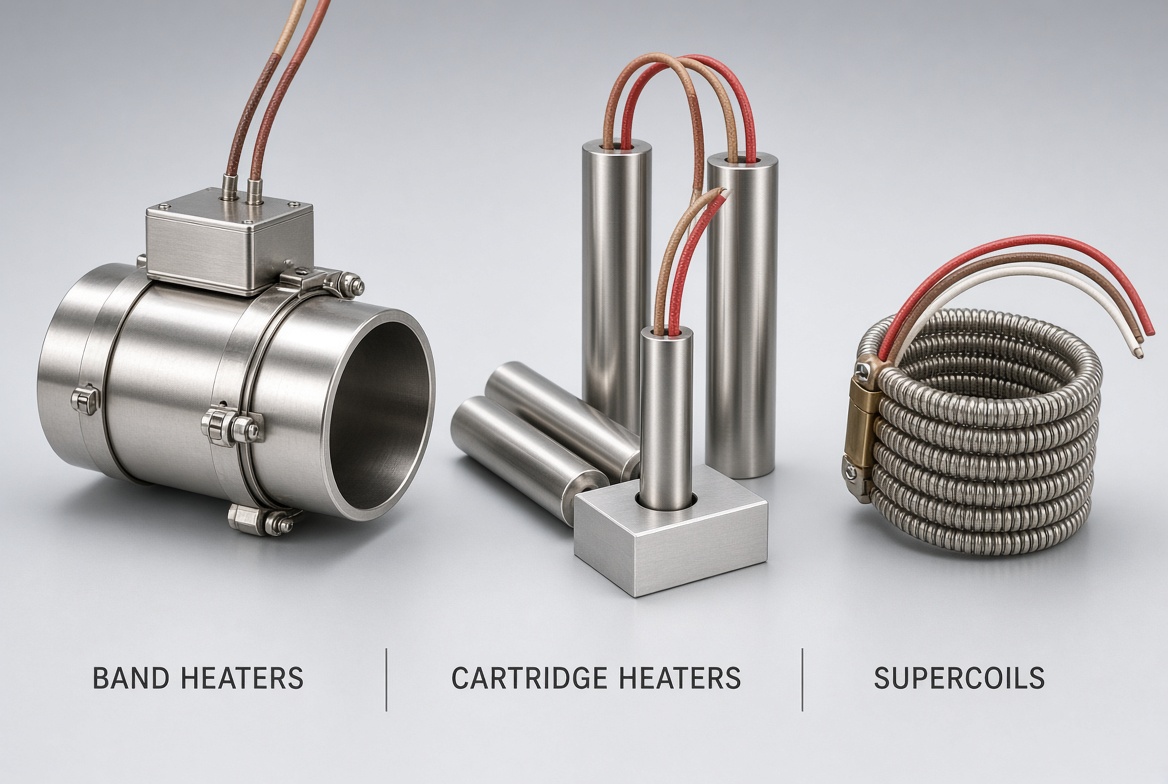
Band Heaters, Cartridge Heaters and Supercoils: Which One Does Your Machine Actually Need?
The short answer: Band heaters clamp around cylindrical barrels and pipes.
Cartridge heaters insert into drilled holes in solid metal. Supercoils wrap
around small components where a band heater will not fit. Incoloy elements
immerse in liquids. Withdrawables heat tanks and can be removed without draining
them. They are not interchangeable, and fitting the wrong type is the most common
reason elements fail early.
Thermocouple Products has manufactured industrial heating elements and temperature
sensors in Edenvale, Gauteng since 1992. This guide sets out how we choose between
them.
Start with the shape of what you are heating
Element type is determined first by geometry, then by temperature.
| What you are heating | Element type |
|---|---|
| Cylindrical barrel, pipe or nozzle | Band heater |
| Solid metal block with a drilled hole | Cartridge heater |
| Small cylinder, no room for a band | Supercoil heater |
| Liquid in a tank, through the wall | Immersion / Incoloy element |
| Liquid in a tank, over the rim | Over-the-side immersion heater |
| Liquid you cannot drain | Ceramic withdrawable |
Get the geometry right first. Everything else follows.
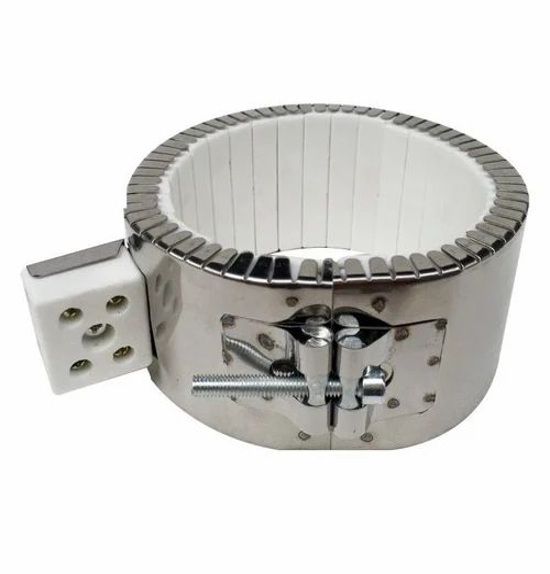
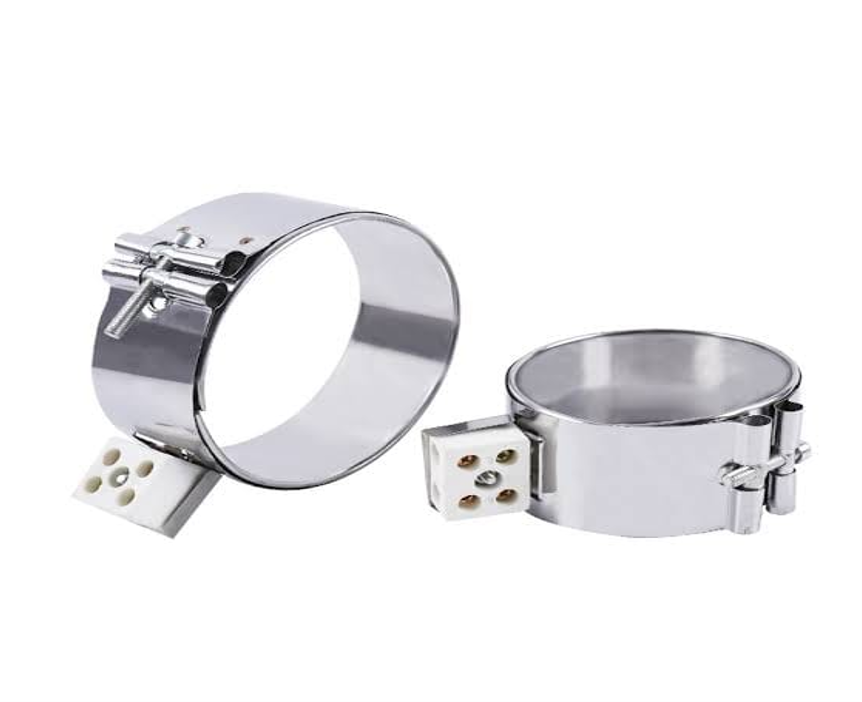
Band heaters: mica or ceramic?
Band heaters clamp around cylindrical surfaces and deliver heat by conduction.
They are the standard on injection moulding and extrusion barrels. The real
decision is which type.
Mica band heaters
A nickel-chromium ribbon wound across a dielectric core, sandwiched between layers
of mica and encased in a stainless or aluminised steel sheath. Mica insulates
electrically while staying thermally conductive and flexible.
- Maximum temperature: 480°C
- Watt density: 20–45 W/in² (3–7 W/cm²)
- Strengths: fast heat-up, high thermal response, lower cost
- Best for: standard barrel and nozzle heating below 480°C on surfaces in
good condition
Ceramic band heaters
Nichrome wire threaded through interlocking steatite ceramic tiles, with a ceramic
fibre insulation blanket between the tiles and the outer shell.
- Maximum temperature: 760°C continuous
- Energy saving: insulation blanket cuts heat loss to atmosphere by 25–30%
- Strengths: higher temperature, lower running cost, longer life
- Best for: high-temperature processing, energy-conscious operations, worn
or slightly out-of-round barrels
The honest comparison
| Mica | Ceramic | |
|---|---|---|
| Max temperature | 480°C | 760°C |
| Heat-up speed | Faster | Slightly slower |
| Running cost | Higher | Lower — 25–30% less loss |
| Tolerance of poor fit | Low | High |
| Initial cost | Lower | Higher |
The point most people miss: ceramic heaters transfer heat by radiation as
well as conduction, so they do not depend entirely on perfect metal-to-metal
contact. If you are repeatedly burning out mica heaters on an older barrel, an
imperfect surface is very likely the cause, and ceramic is the fix.
The insulation blanket also lowers the outside sheath temperature — which means
less waste heat in the workshop and a smaller cooling load.
Cartridge heaters: heating from the inside
A cartridge heater is a tube-shaped element designed to drop into a drilled hole
and heat solid metal from within.
Construction:
- A tightly wound nichrome coil around a ceramic core
- High-purity magnesium oxide (MgO) packed around the coil — electrically
insulating, thermally conductive - Stainless steel or Incoloy outer sheath
- Swaged during manufacture — mechanically compressed to compact the MgO,
eliminate air pockets and maximise heat transfer to the sheath
That swaging step is what separates a good cartridge heater from a poor one. Air
pockets in the MgO create hot spots inside the element, and hot spots are what
burn heaters out.
Typical applications: hot runner manifolds and nozzles, sealing bars,
hot-stamping dies, cutting blades, platens, forming and stamping tools, and with
a threaded fitting or flange, immersion heating of liquids and gases.
Fitting matters. A cartridge heater relies on close contact with the bore. A
hole that is oversized, oval or scaled leaves an air gap, the element cannot shed
its heat into the block, and it overheats internally. If cartridge heaters keep
failing in the same position, check the bore before blaming the element.
Supercoil heaters: for the spaces nothing else fits
A supercoil is a high-watt-density coil heater with a flat cross-section —
typically around 4,2 mm × 2,2 mm — designed to wrap tightly around small
cylindrical components.
Why the flat profile matters: it maximises contact area against the cylinder,
which improves heat transfer compared with a round-section coil of the same power.
The feature most people overlook: supercoils are commonly manufactured with a
Type J or Type K thermocouple built in. Heater and sensor become one
component — one installation instead of two, and the sensor sits exactly where the
heat is generated, which gives far better control than a sensor mounted somewhere
nearby.
Options: supplied open, cast in brass or bronze, or in a stainless steel
jacket for even heat distribution. Armoured cable or wire-braid leads resist
mechanical damage and heat.
Typical applications: hot runner nozzles, sprue bushes, manifolds where a band
heater will not fit, sealing jaws, and semiconductor and laboratory equipment
needing rapid response and tight control.
Incoloy elements: when stainless steel is not enough
Incoloy is a nickel-iron-chromium superalloy used as a sheath where standard 304
or 316 stainless would degrade.
- Continuous operation to 870°C without losing mechanical strength
- Resists limescale and mineral build-up — critical in hard water
- Highly resistant to chloride stress-corrosion cracking — suitable for
chlorinated and marine environments
Where it earns its cost: commercial water heaters in hard-water areas,
foodservice equipment such as fryers, ovens and dishwashers, chemical immersion
tanks, and process air heating.
If elements in a hot water or chemical application are failing prematurely from
scale or pitting, Incoloy is usually the answer.
Ceramic withdrawables: heat you can service without draining
A ceramic withdrawable, sometimes called a bobbin heater, uses spiralled
resistance wire threaded through refractory ceramic bobbins. The assembly slides
into a sealed metal pocket welded into the tank, rather than contacting the
liquid directly.
The advantage is entirely about maintenance. The element can be withdrawn,
inspected and replaced from outside, without draining or cooling the vessel.
That matters most where:
- Draining large volumes is costly or impractical — industrial geysers, fuel and
oil storage - The contents solidify when cold — wax, bitumen, molten metals. Drain those
and you have a far bigger problem than a failed element
Over-the-side immersion heaters: no tank modification
An over-the-side heater installs through the open top of a tank rather than
through the wall. A terminal housing sits over the rim, a cold riser section runs
down the inside wall, and the heated elements sit at the bottom or along the side.
- No drilling or welding is required for installation into open vats, drums and tanks as they are
- Portable, removed, cleaned, serviced or moved between vessels
- Wide material choice: stainless steel, titanium, Incoloy or fluoropolymer
(Teflon) for oils, corrosive chemicals, water and electroplating baths
Ideal for plating lines, parts washers, and any tank you would rather not modify.
Do not forget the cable
High-temperature elements need cable that survives the same environment. Ordinary
PVC-insulated wire will not.
NFG cable — nickel core fibreglass — uses pure nickel or nickel-plated copper
conductors with fibreglass braiding impregnated with high-temperature silicone or
varnish.- Continuous rating: 250°C to 450°C
- Optional stainless steel braid for abrasion resistance in harsh conditions
- Used for: industrial ovens, furnaces and kilns, heating element hook-ups,
commercial stoves, and thermocouple extension runs
The other half: measuring what you are heating
Every element above needs a sensor closing the control loop. A heater with no
accurate measurement is just a fire risk with a plug on it.
Thermocouple Products manufactures both halves:
- Thermocouples types J, K, T, E, R, S and B, from −270°C to +1 600°C
- Pt100 RTDs for higher accuracy below 600°C
- Extension cable matched to type, because ordinary copper wire introduces
measurement error - Controllers and indicators — to run the loop
On a typical injection moulding machine, that means band heaters on the barrel,
cartridge heaters in the manifold, supercoils on the nozzles, thermocouples in
every zone, and the cable connecting it all — from one manufacturer, built locally.
The five questions we ask before recommending anything
- What are you heating? Cylindrical barrel, solid block, liquid, air?
- What temperature do you need? Normal running and maximum excursion
- What are the dimensions? Diameter, length, bore size, wattage, voltage
- What is the environment? Corrosive, wet, high vibration, hard water?
- What failed last time? If you are replacing something, how it failed is
often the single most useful piece of information
Answer those five and we can specify the right element with confidence.
Built to order in Edenvale
Thermocouple Products manufactures heating elements and temperature sensors to
order at its facility in Edenvale, Gauteng — custom dimensions, cutouts,
thermocouple holes, terminal types and sheath materials, with no import lead
times and no minimum order quantities.If you are unsure which element suits your application, describe the machine and
the process and we will advise.Request a Quote → Call (011) 452-6617 ·
Email tcprod@mweb.co.za
FAQ schema for this page
What is the difference between a mica and a ceramic band heater?
A mica band heater operates up to 480°C and uses mica sheet insulation, giving
fast heat-up at lower cost. A ceramic band heater operates up to 760°C and
includes a ceramic fibre insulation blanket that reduces heat loss to atmosphere
by 25–30%, lowering running costs and extending element life. Ceramic heaters also
transfer heat by radiation as well as conduction, making them more tolerant of
worn or slightly out-of-round surfaces.
When should I use a cartridge heater instead of a band heater?
Use a cartridge heater when heating a solid metal block with a drilled hole, such
as a hot runner manifold, sealing bar, platen or forming die. Use a band heater
when heating a cylindrical external surface such as an extruder barrel, pipe or
nozzle.
What is a supercoil heater?
A supercoil heater is a compact, high-watt-density coil heater with a flat
cross-section, typically around 4,2 mm × 2,2 mm, designed for tight spaces where a
band heater will not fit. Supercoils are frequently manufactured with a Type J or
Type K thermocouple built in, combining heater and sensor in one component.
Why use an Incoloy heating element instead of stainless steel?
Incoloy is a nickel-iron-chromium superalloy that operates continuously to 870°C
and resists limescale, pitting and chloride stress-corrosion cracking. It is used
in hard water, chlorinated water, marine environments and chemical immersion
applications where 304 or 316 stainless steel would degrade prematurely.
What is a ceramic withdrawable heating element?
A ceramic withdrawable, or bobbin heater, uses resistance wire threaded through
refractory ceramic bobbins housed inside a sealed pocket in the tank wall. The
element can be removed, inspected and replaced from outside without draining or
cooling the vessel, which is essential where contents solidify when cold, such as
wax, bitumen or molten metals.