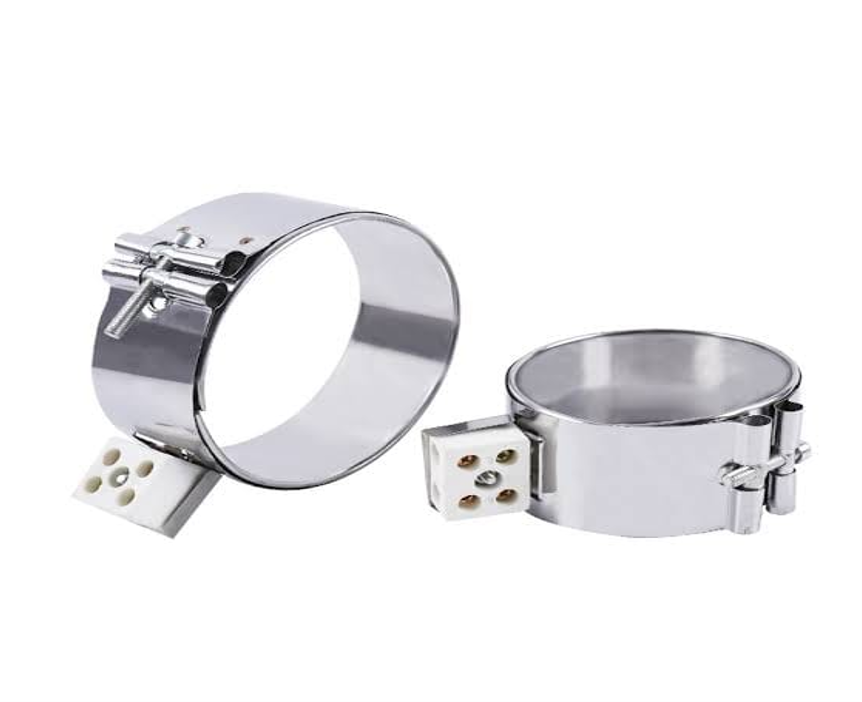
A mica band heater is an electric heating element designed to clamp around cylindrical surfaces such as barrels, pipes, and nozzles to deliver uniform heat through conduction.
How It Is Constructed
Resistance Wire: A nickel-chromium (NiCr) ribbon or wire is wound precisely across a dielectric core.
Mica Insulation: Layers of high-grade natural or synthetic mica sandwich the heating wire. Mica is chosen because it provides high electrical insulation while remaining thermally conductive and flexible.
Outer Sheath: The assembly is encased in a corrosion-resistant metal sheath (usually stainless steel or aluminized steel) that provides structural integrity and oxidation resistance.
Clamping System: Integrated straps, flanges, or screw clamps pull the heater tightly against the cylindrical barrel to minimize air gaps and maximize conductive heat transfer.
Key Specifications & Features
Operating Temperature: Typically rated up to 480°C .
Watt Density: Usually operates between 20 to 45 W/in² (3 to 7 W/cm²).
Efficiency: Provides fast heat-up times and high thermal response due to the thin profile of mica insulation.
Customization: Often manufactured with custom cutouts, holes for thermocouples, and various terminal types (leads, screw terminals, or plug receptacles).
Common Applications
Plastics Processing: Heating the barrels and nozzles of injection molding, extrusion, and blow-molding machinery.
Packaging Equipment: Sealing bars, shrink tunnels, and hot-melt adhesive systems.
Piping & Drums: Maintaining process temperatures for fluids in chemical, oil, and food processing pipelines