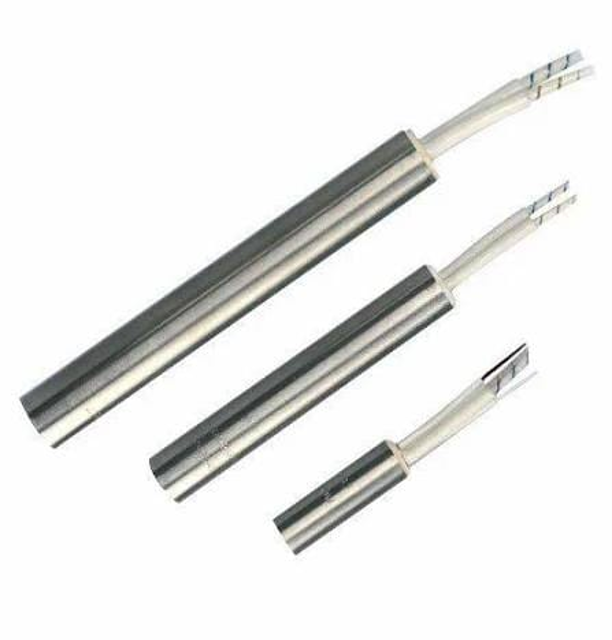
A cartridge heating element (or cartridge heater) is a tube-shaped, heavy-duty industrial electric heating component designed primarily for insertion into drilled metal holes to provide localized, high-density contact heating.
Internal Structure & How It Works
Resistance Wire (Nichrome Coil): A tightly wound nickel-chromium wire runs through the center or around a ceramic core. When electrical current passes through, resistance generates intense heat via Joule heating.
Dielectric Insulation (Magnesium Oxide - MgO): The space between the wire coil and the outer sheath is packed with high-purity magnesium oxide powder. MgO acts as an electrical insulator while rapidly conducting thermal energy outward.
Metal Sheath: The outer casing—typically made of stainless steel or Incoloy—protects the internal assembly from oxidation, physical damage, and corrosion.
Swaging Process: During manufacturing, the heater is mechanically compressed (swaged) to compact the MgO powder. This eliminates air pockets and maximizes heat transfer efficiency directly to the outer surface.
Lead Terminals: Power wires exit from one end, allowing easy wiring even when inserted deeply into solid metal blocks.
Common Applications
3D Printers & Injection Molding: Heating hot ends, nozzles, manifolds, and runner systems.
Packaging Machinery: Sealing bars, hot-stamping dies, and cutting blades.
Platens and Dies: Metal stamping, forming tools, and semiconductor manufacturing equipment.
Immersion Heating: Liquids or gases when fitted with threaded fittings or protective flanges.